
How Do We Imagine the Future of the Anthroposophical Society?
Nathaniel:
Well welcome everyone! I am here with Roos Naves, and I wanted to dedicate a little conversation to an ongoing process that is really interesting and also to some extent challenging. And it has to do with the kind of form, the structure, of the Anthroposophical Society. Now, I don't know if you're connected with the Anthroposophical Society, if you're listening to this, or you're perhaps a member or interested in it, or maybe a critic of it, whatever that may be. It doesn't matter for what we're going to talk about today. Thank you for joining me, Roos.
Roos:
Hello. Thank you for inviting me.
Nathaniel:
I want to start off with just a little introduction to the history of the Society before we jump in…One of the really fascinating aspects for me of the Anthroposophical Society is that it was created as a form where people who were interested in trying to expand knowledge into the spiritual of the human being and the world could be in association together through newsletters and also through events like conferences, but also where they could actually pool resources and create a school where research could go on in different fields and departments, which has its center at the Goetheanum. And I think this is a really interesting model. In the United States where I'm from, we have a lot of colleges and independent research institutes. One of the challenges that is baked into doing something new is getting money together without having to make money—how to take money from big business, or from the state. If you take money from the state, then often there can be a lot of conventional ideas that have to accommodate bureaucratic processes. How do you create a college or research institution where you can go after something in the spirit that you're inspired to do with your colleagues and not be influenced in a negative way?
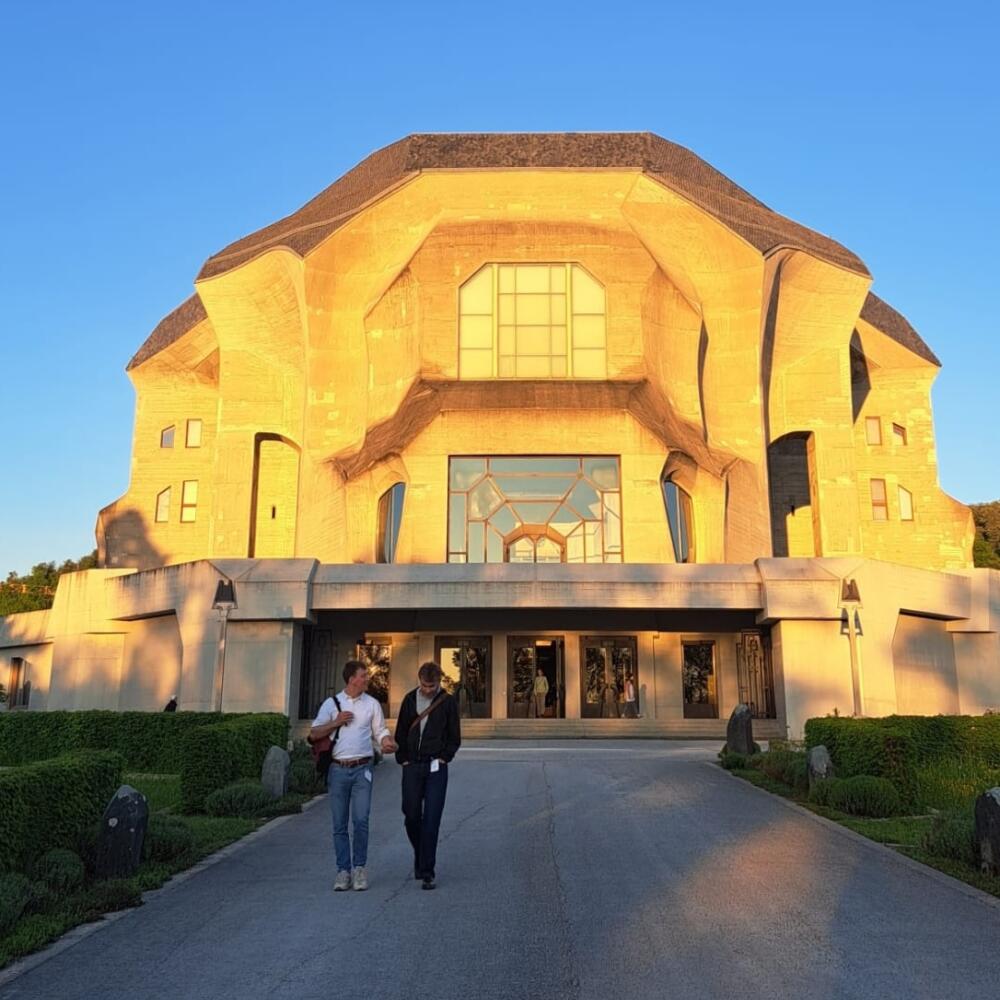
And the Anthroposophical Society, at least one part of it was envisioned as far as I understand, 100 years ago, was to create the Goetheanum and for all these Sections in medicine, natural science, etc. It's been around for a while and there's been a long-standing conversation about the structure of the Society. There's the General Society, which is worldwide. But then there's also these country Societies that exist in different countries, but there's this one constitution of the General Society that is connected to the Goetheanum and the school. There has been a process of updating the constitution and statutes, creating something that feels appropriate for the work. And there's been a lot of conversation and intense also debate over the years. You have been in the middle of this process with a convent, a group of people that's worked for a year to try to come up with new statutes. Can you tell us a little bit about that?
Roos:
Well, I think it's one of the most challenging things I've done in my 31 years being on this Earth. It's an interesting combination of looking at the future: How do you want to be, and how do you want to organize yourselves? And then at the same time taking on everything which happened in the past. So, it's very exciting and at the same time difficult going in-between: How do you look forward? Taking on everything which happened in the past, but not being burdened by it. And maybe that's one of the good things that I'm 31. I'm the youngest of the convent members, and I haven't been burdened by the past. There's a really big conversation about whether the Christmas Statutes are respected or not [the statutes from 2023]. And that's one of the questions we have carried while coming up with new concepts for the renewed statutes. How do you incorporate the impulse of Christmas Conference 1924—25, which is this amazing idea that all of us are free human beings, but that we carry together this collective impulse of bringing anthroposophy into the world.
So how do you do that within your own individual freedom but with a collective spirit? And then there's a really nice tension between how do you do it financially? And how do you do it by the law? How do you do it by very practical means? And at the same time, how do you want the culture of your own organization or association? How do you want that to be? And if you have a form, it doesn't mean you have the culture you want to have. And if you have a really nice culture, but the form doesn't belong to it, there will always be this interesting yin-yang tension between the two. And we need to address both. But the main purpose of the convent was to write renewed statutes before April 2027, because that's the date we're going to vote on the new statutes.
Nathaniel:
So the process until now has been that you and 11 other people have met every month for a year and then you have created a draft. It was first made public a month ago at the general meeting of the Anthroposophical Society. And the idea is now that it’s been over a year's time, it's possible to have conversations about it, talk about it, to look into our current situation, our past and the future, and see what can be developed from this draft for a vote in 2027, in April. Which could be an acceptance, or rejection…it’s just there's this process underway…You want to have conversations with younger people around these questions. Is there anything more you want to say about that?
Roos:
I think it's really important. I would be so joyful if I could meet young members of the Society, to talk about this topic because we are shaping a Society which will last hopefully for a long time, and we will be part of that for a very long time, or I hope we will be part of it for a very long time. I've met lovely members, but their average age is around 70 years old. I feel that there's a really important impulse to give from the younger generation of the members because that's the interesting thing about the tension between the past and the future. I don't want to offend the older members, but they carry the past and that's good. The past needs to be there. But at the same time, we also need to bring in the future. And that's where the younger members come in. So, I am organizing two online moments on the 16th of June at 8:00 AM Central European Time, and on the 6th of October at 4:00 PM Central European Time.
Nathaniel:
I am excited to see how this year unfolds. I'm sure I'll be part of many of the conversations myself. Thank you for all the work you're doing!
Contact Roos at roosnaves@antroposofie.nl to join the call.